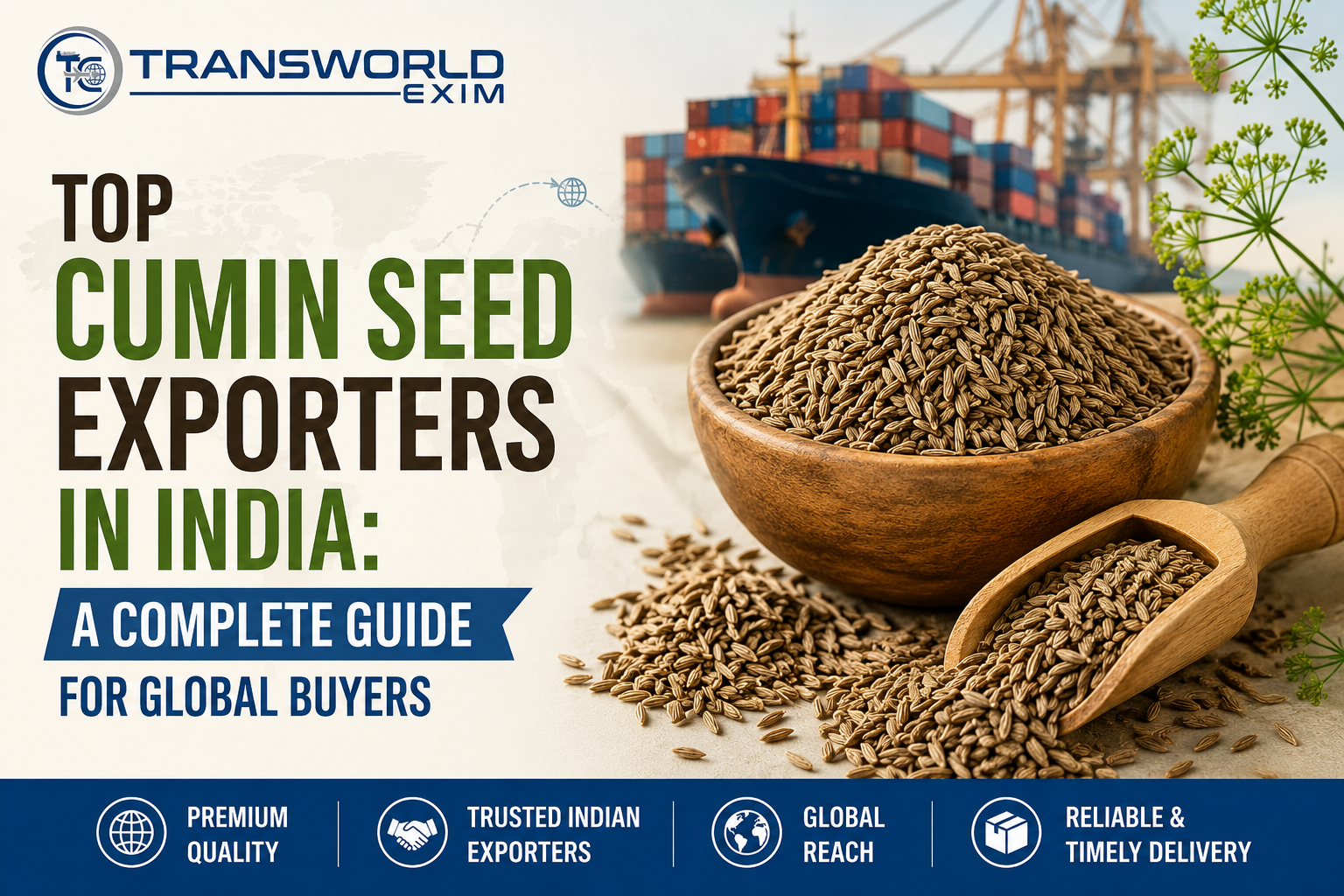
India is a major source of cumin, also called jeera, for international spice buyers. For U.S. importers, wholesalers, food manufacturers, distributors, and private-label businesses, the opportunity is attractive, but choosing the right supplier requires more than comparing a few cumin export prices.
The right exporter should be able to consistently meet your product specifications, quality expectations, testing requirements, packaging needs, documentation standards, and delivery schedule.
Below is a practical guide to cumin exporters in India, with Transworld Exim featured first, followed by other established Indian companies buyers may consider during supplier evaluation.
Top Cumin Seed Exporters in India
1. Transworld Exim - Featured Indian Cumin Exporter
Transworld Exim, headquartered in Ahmedabad, Gujarat, is an India-based agricultural export company supplying international buyers across spices and other agricultural products.
Founded in 2025 by Ronak Patel and Jenil Patel, Transworld Exim focuses on direct sourcing, quality inspection, processing, packaging, export documentation, and logistics coordination. The company currently works across 10+ agricultural export products and states a 15 MT minimum order quantity for bulk export requirements.
For buyers sourcing Indian cumin seeds, the company emphasizes transparent communication, customized product and packaging requirements, competitive sourcing, and long-term business relationships. Its stated target is to respond to quotation inquiries within 24 hours.
Buyers can approach Transworld Exim with their required cumin type, quantity, quality specification, packaging format, and destination to discuss a bulk supply requirement.
2. Synthite Industries
Synthite Industries is an established Indian spice and spice-extract company with a significant presence in the international spice industry. Buyers evaluating the company should confirm whether its current product offering and commercial model match their specific requirement for whole cumin seeds or processed cumin products.
3. Nedspice Group
Nedspice is an international spice business with sourcing and supply operations connected to major spice-producing regions. Buyers considering the company should evaluate its available cumin products, specifications, market coverage, and order requirements for their destination.
4. Organic Products India
Organic Products India operates in the Indian agricultural and organic-products space. For buyers specifically seeking organic cumin seeds, supplier verification should include current organic certification, applicable standards, product specifications, and documentation for the destination market.
5. Virdhara International
Virdhara International is among the Indian agricultural and spice exporters that buyers may evaluate when sourcing products such as cumin. Before ordering, buyers should verify current cumin availability, specifications, testing procedures, MOQ, packaging formats, and export documentation.
Important: The companies above should be treated as potential suppliers to evaluate, not as an independently verified national ranking. Supplier suitability depends on the buyer's specification, destination, order size, compliance requirements, and commercial terms.
What Makes a Reliable Cumin Seed Supplier?
A good cumin seed supplier in India should provide clear answers about sourcing, processing, specifications, testing, packaging, and logistics.
Ask for the product specification before discussing price in detail. Important parameters may include purity, moisture, foreign matter, seed size, appearance, and volatile oil characteristics.
For food applications, buyers may also require testing for pesticide residues, microbial contamination, heavy metals, aflatoxins, Salmonella, E. coli, and other relevant parameters.
A Certificate of Analysis (COA) and lot or batch identification can help buyers connect test results to a particular shipment.
How Indian Cumin Is Prepared for Export
Cumin may be cleaned, sorted, graded, processed, and packed before export. Depending on the supplier and application, buyers may encounter machine-cleaned cumin, Sortex-cleaned cumin, bold cumin seeds, or steam-sterilized cumin.
These terms should be verified rather than assumed. Ask what processing was performed and which final specification it is intended to achieve.
Buyers should also distinguish between whole cumin seeds, cumin powder, and ground cumin, because processing requirements and commercial suitability can differ considerably.
What U.S. Buyers Should Check
For U.S. importers, supplier evaluation should cover both the Indian export side and the buyer's own import responsibilities.
Request accurate product specifications, testing records, commercial documents, packaging details, and traceability information. The U.S. importer should separately confirm applicable U.S. Food and Drug Administration (FDA) requirements and Foreign Supplier Verification Program (FSVP) obligations.
Before approving an order, confirm:
- Product specification and tolerances
- Sample approval procedure
- Testing and COA requirements
- Batch or lot identification
- Packaging and net weight
- Country-of-origin documentation
- Incoterms such as FOB, CFR, or CIF
- Lead time and shipment schedule
- Quality-dispute procedures
This can reduce the risk of receiving cumin that does not match the agreed purchase specification.
What Affects Cumin Export Price?
There is no single fixed cumin price per kg for international trade.
The final quotation can vary based on seed grade, purity, crop conditions, cleaning and sorting, testing requirements, packaging, quantity, freight, destination, and payment or shipping terms.
That means two quotations are not necessarily comparable simply because both suppliers are offering “Indian cumin seeds.” Buyers should compare the complete specification and commercial package.
MOQ is also important. Bulk buyers should confirm the minimum order quantity before moving into sampling, negotiations, and shipment planning.
How to Choose the Right Indian Cumin Exporter
Before placing a large order, ask five basic questions:
Can the supplier meet your written specification?
Can the supplier provide relevant testing and traceability documents?
Can the agreed quality be maintained across repeat shipments?
Are packaging, pricing, Incoterms, lead time, and payment terms clearly documented?
Does the supplier communicate quickly when requirements or shipment conditions change?
A supplier that handles these questions transparently is generally easier to work with than one that only focuses on offering the lowest initial price.
Why Transworld Exim Can Be a Practical Option
For buyers looking for an Indian cumin supplier with a direct export focus, Transworld Exim offers a combination of sourcing, quality coordination, customized requirements, packaging support, and logistics handling.
Its Ahmedabad base places the company within Gujarat's important agricultural and spice-trading ecosystem. The company also works across multiple agricultural categories, giving buyers the possibility of sourcing additional Indian products through the same export relationship.
With a stated 15 MT MOQ for bulk export requirements and a 24-hour quotation-response target, Transworld Exim is positioned toward commercial buyers rather than small consumer purchases.
The best next step for a serious buyer is to share the required cumin specification, quantity, destination, packaging preference, and intended application. That creates a clearer basis for quotation and supplier comparison.
Frequently Asked Questions
Who are the top cumin exporters in India?
There is no single universally accepted ranking of the top cumin exporters. Buyers should compare exporters based on product quality, testing, traceability, processing capability, MOQ, documentation, pricing, and supply reliability.
What is the difference between cumin and jeera?
Cumin and jeera are names for the same spice. Jeera is commonly used in India, while cumin is the standard English term used in international trade.
What quality specifications should I request for cumin seeds?
Ask about purity, moisture, foreign matter, seed size, appearance, processing method, and relevant microbiological or contaminant testing based on your application and destination.
Can I import bulk Indian cumin seeds into the USA?
Yes, but U.S. buyers must verify the import requirements that apply to their particular product and business, including applicable FDA and FSVP obligations.
What is the MOQ for bulk cumin?
There is no universal MOQ. It varies by exporter, product specification, processing, packaging, and order size. Transworld Exim currently states a 15 MT MOQ for bulk export requirements.
Should I request a COA before buying cumin?
For commercial food purchases, requesting appropriate analytical documentation can be useful. The COA should be relevant to the shipment or batch and should match the agreed purchase specification.
How can I compare two cumin suppliers?
Compare the complete offer rather than price alone: specification, sample, testing, packaging, MOQ, Incoterms, lead time, documentation, communication, and the supplier's ability to maintain consistency across repeat orders.