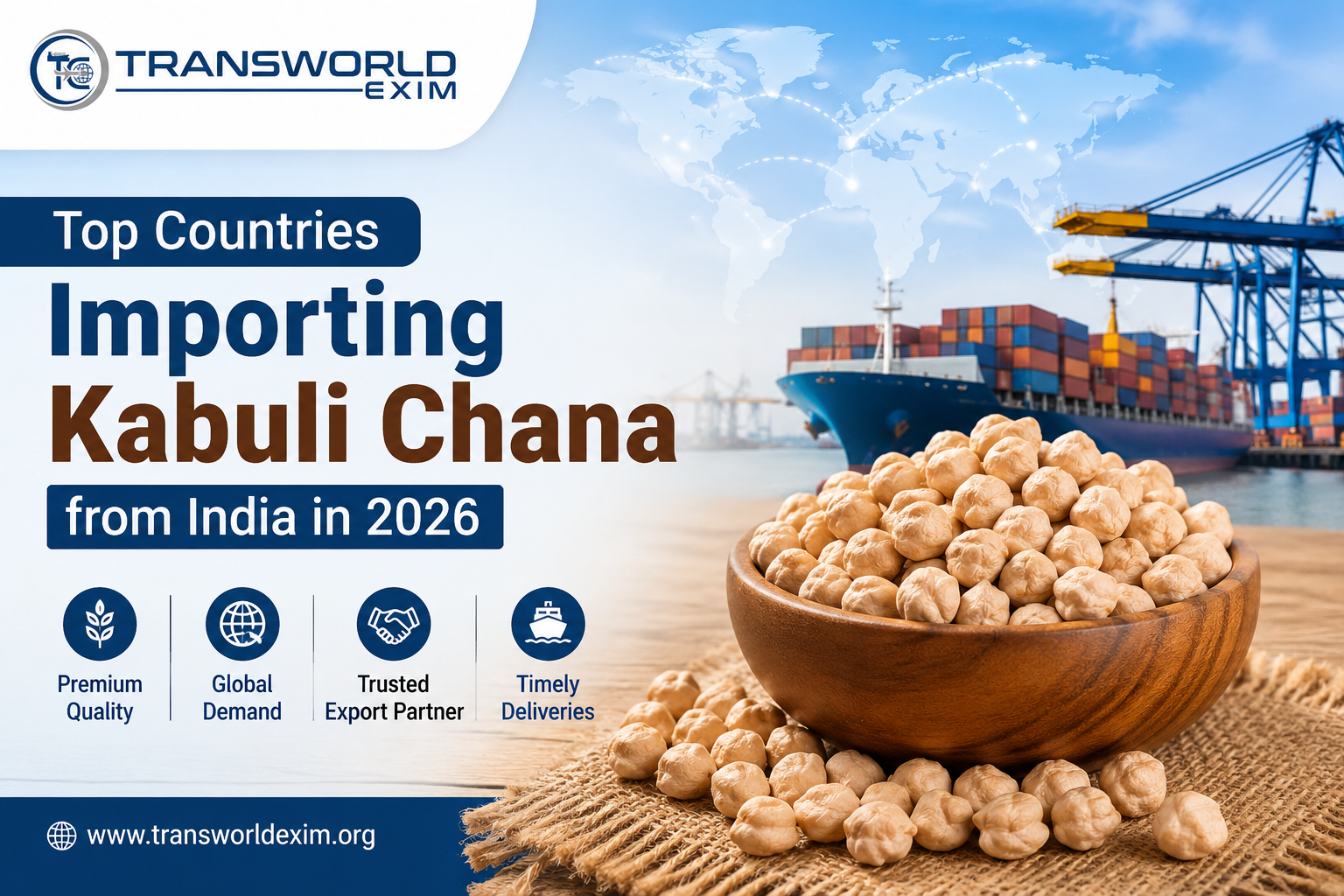
For buyers looking to source kabuli chana from India, the key question is no longer simply whether India can supply the product. It is which international markets are actively buying Indian kabuli chickpeas, what those markets need, and how a buyer can source with fewer quality, documentation, and logistics surprises.
Recent 2026 India-origin shipment data highlighted in the research brief points to the United States as one of the leading destinations, while markets including Vietnam, Pakistan, Uganda, Malaysia, and Tanzania also show meaningful activity. The exact ranking can vary by reporting period and product classification, so buyers should distinguish Kabuli chana from broader chickpea or pulse data.
For U.S. importers, wholesalers, distributors, food manufacturers, and private-label businesses, that distinction matters. India offers a substantial agricultural sourcing base, but the right supplier still needs to meet the buyer's specifications, documentation requirements, packaging needs, and shipment expectations.
Which countries are importing kabuli chana from India in 2026?
The United States stands out as a particularly important market in current India-origin shipment data. Other markets appearing prominently in available 2026 trade and shipment coverage include Vietnam, Pakistan, Uganda, Malaysia, and Tanzania, with additional demand across international markets.
These destinations matter for different reasons. Some represent established pulse-trading channels, while others provide opportunities for wholesalers, processors, retailers, and foodservice buyers seeking consistent supplies of kabuli chickpeas.
The most useful way to read the market is not simply by asking which country is number one. Buyers and exporters should also consider shipment consistency, preferred specifications, price sensitivity, regulatory requirements, and the type of customers served.
Why the U.S. market matters for Indian kabuli chana exporters
For an American buyer, India is relevant because it combines a large agricultural supply ecosystem with established export infrastructure and access to multiple grades and packaging formats.
The U.S. opportunity also extends beyond traditional commodity trading. Indian kabuli chana can be relevant to wholesalers, ethnic food distributors, packaged-food brands, restaurant suppliers, and processors that need dependable bulk supply.
U.S. buyers should also pay attention to compliance. Imported food is subject to U.S. requirements overseen by the U.S. Food and Drug Administration (FDA), and applicable importers may have obligations under the Foreign Supplier Verification Programs (FSVP) rule. Requirements can include supplier verification, food-safety controls, facility registration where applicable, labeling, and supporting documentation.
That makes supplier selection just as important as commodity pricing.
Understanding Indian kabuli chana exports and global demand
One important research issue is classification. APEDA identifies Kabuli Chana under ITC-HS 07132010, while Bengal Gram or Desi Chana is separately identified under 07132020 within the broader chickpea heading. That means broad "chickpea export" figures should not automatically be treated as Kabuli chana figures.
At the broader pulse level, APEDA reported India's exports of pulses at 1,000,547 metric tonnes valued at $969.53 million in FY 2025-26. This demonstrates the scale of India's pulse-export ecosystem, but it should not be interpreted as Kabuli chana export volume specifically.
For businesses tracking Indian kabuli chana global demand, the practical takeaway is clear: use product-specific classification and a defined reporting period before comparing countries.
What international buyers look for in kabuli chickpeas
A serious buyer normally evaluates more than origin.
Specifications may include grain size, moisture, purity, foreign matter, damaged or discoloured grains, cleaning standard, packaging, and shelf-life expectations. Buyers may also request samples, inspection records, laboratory documentation, or a certificate of analysis depending on the transaction.
For bulk purchases, the required grade should be agreed before quotation. Terms such as 7 mm, 8 mm, 9 mm, or 10 mm may be commercially relevant, but the exact specification should be confirmed with the buyer rather than assumed.
This is where a clear supplier communication process can reduce costly misunderstandings.
How to export kabuli chana from India
The export process starts well before a container reaches the port.
An exporter generally needs to manage buyer specifications, commercial terms, product preparation, packaging, documentation, customs procedures, and international logistics. Depending on the destination and transaction, documentation can include commercial invoices, packing lists, certificates of origin, phytosanitary documentation where required, and other compliance records.
For U.S. shipments, the buyer and supplier should also clarify which party is responsible for applicable FDA and FSVP-related requirements.
Pricing should be handled with similar care. A single "2026 export price" is rarely meaningful because quotations can change with crop availability, grade, quantity, cleaning, packaging, origin, freight rates, destination, and Incoterms such as FOB or CIF.
The better approach is to quote against an actual specification and delivery destination.
Why supplier reliability matters as much as price
A low commodity price is not necessarily a low landed cost.
Inconsistent quality, unclear specifications, delayed documents, poor packaging, or shipment disruptions can quickly erase the benefit of a cheaper initial quotation. International buyers therefore tend to value suppliers that can communicate clearly, document what they are selling, and maintain consistency across repeat orders.
Transworld Exim, an Ahmedabad-based Indian agricultural exporter, positions itself around direct sourcing, quality inspection and processing, customized specifications and packaging, transparent communication, and international logistics support. The company currently handles multiple agricultural product categories and accepts bulk orders starting from 15 MT, according to its stated business information.
For a buyer comparing Indian suppliers, those operational details are often more useful than a generic claim of being a "leading exporter."
Choosing an Indian kabuli chana supplier for the U.S. market
Before placing a bulk order, buyers should establish five things clearly: the exact product specification, required quantity, packaging format, quality documentation, and delivery terms.
It is also sensible to ask whether the exporter can provide samples, support buyer-specific specifications, and coordinate documentation for the destination market.
Transworld Exim states that it provides a 24-hour quotation response for buyer inquiries and follows a quality-focused export process. For U.S. and other international buyers, the next step should be a specification-led discussion rather than a generic request for "the best price."
Share the required Kabuli chana grade, quantity, packaging, and destination with Transworld Exim to discuss sourcing and an export quotation tailored to the shipment.
Frequently Asked Questions
Which countries import kabuli chana from India in 2026?
Recent India-origin shipment data highlighted for 2026 identifies the United States, Vietnam, Pakistan, Uganda, Malaysia, and Tanzania among important destination markets. Rankings can vary by reporting period and HS classification.
Is the United States a major buyer of Indian kabuli chana?
Yes. Recent 2026 shipment data places the U.S. among the important destinations for Indian Kabuli chana, making it a relevant market for Indian exporters and U.S. importers evaluating Indian supply.
What is the HS code for Kabuli chana in India?
APEDA identifies Kabuli Chana under ITC-HS 07132010. Buyers should distinguish it from other chickpea classifications when reviewing trade statistics.
How can I source kabuli chana from India?
Start by defining the required size, quality, quantity, packaging, destination, and delivery terms. Then compare suppliers based on documentation, quality controls, communication, and export capability, not price alone.
What documents are needed to import kabuli chana into the U.S.?
Requirements depend on the shipment and applicable regulations, but U.S. food imports may involve FDA requirements and, for covered importers, FSVP obligations. Product and shipment documentation should be confirmed before dispatch.
Can I buy kabuli chana in bulk from Transworld Exim?
Yes. Transworld Exim states that it handles bulk agricultural export orders with a 15 MT minimum order quantity and can discuss customized product specifications and packaging.